



Outdoor wall lights are the most useful exterior fixture you can buy, because they do three jobs at once. They let people find the door, they make the house look occupied and cared for, and they are the main thing anyone sees of your home after dark.
They are also the fixture most often bought on looks alone and regretted within two winters. So before the ideas, one section of specification, because it is what separates a light that lasts from a light that fills with water.
Get the IP rating right, or nothing else matters
IP ratings tell you what a fixture can survive. Two digits: the first is solids, the second is water.
For outdoor wall lights, IP44 is the realistic minimum. It handles splashing water from any direction, which covers a wall under an eave or a sheltered porch.
IP65 is what you want for anything genuinely exposed: an open facade, a wall with no overhang, anywhere driving rain hits directly. It is protected against water jets, and it is the rating worth paying for if you are unsure.
The Phillips IP65 Waterproof Wall Lamp, from $230, is specified for exactly this.

The other half of durability is what the fixture is made of. Coastal properties are brutal on metal, and salt air will find any weak finish. Marble and stone bodies hold up well and do not corrode, which is part of why they appear so often in NYRA's outdoor range.
The front door: two lights, not one
The instinct is one light above the door. It is the most common exterior lighting setup and it is the least flattering, because light from directly overhead drops shadow straight down onto the face of whoever is standing there.
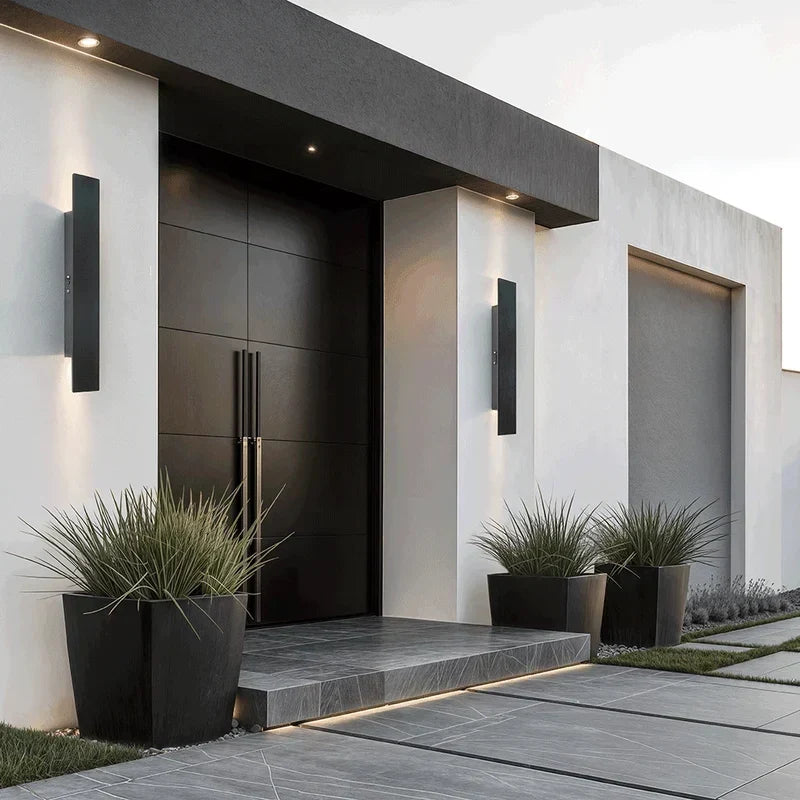
Two wall lights, one either side of the door at roughly eye level, is the better arrangement. Light arrives across the face instead of on top of it, the entrance reads as symmetrical, and the doorway gains presence.
Mount them at roughly 1.6m to 1.7m from the ground, which puts the light source near eye height for an adult. If your door is unusually tall or sits up a flight of steps, adjust so the fixtures relate to the door, not to the ground.
If there is only room for one, put it on the handle side, so you are not reaching into your own shadow with a key.
Pieces that suit entrances:
Zoya Outdoor Marble Wall Light, from $245. Marble body, so nothing corrodes.

Arlen Outdoor Wall Light, $289.

Brighton Acrylic Outdoor Wall Lamp, from $259.

Vetrana Modern Outdoor Sconce, from $145, the entry point if you are doing several elevations.

Facades: up, down, or both
This is where outdoor wall lighting stops being functional and starts being architectural. Three approaches, and they produce completely different results.
Downlighting washes light down the wall from a fixture mounted high. It is the safest option, it lights the ground below, and it is what you want on anything you walk past.
Uplighting throws light up the wall and grazes the surface. On brick, stone or render with any texture, this is the one that looks expensive, because the raking light catches every irregularity and turns a flat wall into relief. On a perfectly smooth wall it does much less.
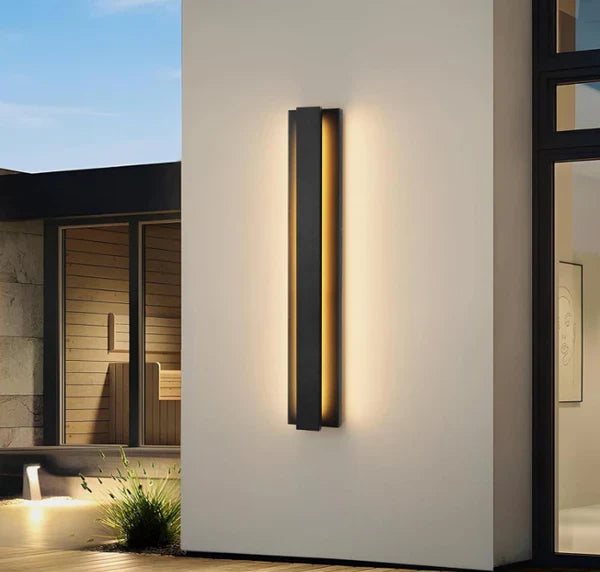
Up and down fixtures do both from one point, producing the double cone of light you see on contemporary houses. They are efficient, they look deliberate, and they suit modern facades with clean lines. The NYRA Outdoor LED Wall lamp, from $400, and the Martin LED Outdoor Wall Lamp, from $400, sit in this category.
The rule for facades is restraint. Lighting every wall equally produces a house that looks like a car park. Pick the features worth showing, the entrance, a texture, a good material, and leave the rest dark. Contrast is what makes it read.
Patios: light low, light warm, light less
The instinct on a patio is to light it like a room. Do not.
Outdoor spaces work in the evening precisely because they are darker than indoors. Blast a patio with bright light and you get a space that feels like a loading bay, and you lose the sky entirely.
Wall lights on a patio should be low output, warm, and positioned so you never see the source from a seated position. You are lighting the space enough to move through it and see faces, not enough to read a newspaper.
Warm white, 2700K to 3000K, is right for anywhere people sit. It flatters skin and it reads as hospitable. Save cooler light for security and utility areas, where nobody is trying to relax.
The Olivia outdoor wall lamp, from $300, suits terraces and balconies.

The mistakes worth avoiding
Lighting spilling into bedroom windows, yours or a neighbour's. Check where the beam actually lands, not where you assumed it would.
Motion sensors on everything. They belong on a side return or a driveway. On a front door they turn every passing cat into an event, and a permanently triggering light is worse than none.
Mixed colour temperatures across one elevation. A 2700K porch light next to a 4000K facade light is visible from the street and it looks like an accident, because it is one.
Fixtures aimed at the sky. Beyond wasting light, it contributes to light pollution and it is increasingly restricted in some areas. Aim light at surfaces you want to see, not into the air.
Indoor fixtures used outside. An IP20 fitting under a porch will survive a summer and fail in the first real storm.
A plan for a typical house
Two wall lights either side of the front door, roughly 1.6m to 1.7m up, warm white.
One or two up and down fixtures on the best textured elevation, and nothing on the plain ones.
Low, warm wall lights on the patio, positioned out of sightlines.
Motion sensing on the side return and bins area only.
IP65 anywhere without an overhang, IP44 minimum under shelter.
One colour temperature across everything the street can see.
Getting it specified
Every NYRA outdoor fixture is made to your destination country's voltage, wiring and certification requirements, and can be customised on finish, size and light colour. Outdoor wiring should be installed by a qualified electrician.
Browse outdoor lights, or book a free consultation and send photos of your elevation for a recommendation.
FAQ
What IP rating do outdoor wall lights need?
IP44 is the minimum for sheltered positions such as under an eave or porch. IP65 is what you want for fully exposed walls where driving rain hits directly.
How high should outdoor wall lights be mounted?
Roughly 1.6m to 1.7m from the ground for entrance lights, which puts the source near adult eye height. Adjust so the fixtures relate to the door rather than to the ground if the entrance sits up steps.
Should I put one light or two by the front door?
Two, one either side, is better. A single light directly above the door casts shadow straight down onto the face of anyone standing there. If only one is possible, mount it on the handle side.
What colour temperature for outdoor lighting?
Warm white, 2700K to 3000K, for entrances and anywhere people sit. Cooler light is reserved for security and utility areas. Keep one temperature across any elevation visible from the street.
Do outdoor wall lights need motion sensors?
Only where they are genuinely useful, such as a side return, bin store or driveway. On a front door, sensors trigger constantly and are more irritating than helpful.


Leave a comment
All comments are moderated before being published.
This site is protected by hCaptcha and the hCaptcha Privacy Policy and Terms of Service apply.