






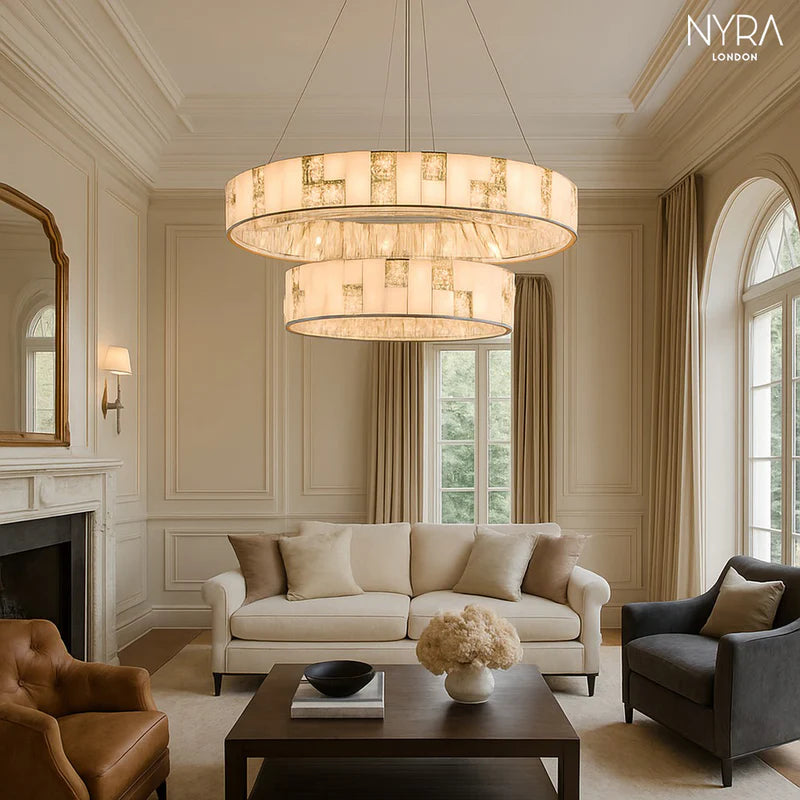


Every chandelier installation problem is cheaper to solve before the fixture arrives than after.
That is the whole point of this guide. Most of what goes wrong, the ceiling that cannot take the weight, the drop that is 30cm off, the fixture you can never clean, is decided before anyone picks up a screwdriver. Once the box is open, your options narrow fast.
One thing first, stated plainly: chandelier installation involves mains electricity and a heavy object suspended above people's heads. Ceiling fixtures should be installed by a qualified electrician. This guide is here so you know what to check and what to ask, not so you can do the wiring yourself.
The first question: can your ceiling take it?
This is the one that matters most and gets asked least.
A light fitting weighs very little. A crystal chandelier does not. Somewhere between those two, your ceiling stops being adequate.
The threshold worth remembering: for any fixture exceeding 10kg, professional installation and reinforced ceiling support are advised. A standard ceiling rose and a plasterboard fixing are designed for a lampshade, not for a chandelier.
What needs checking:
Is there a joist where the fixture will hang? Plasterboard alone will not hold a chandelier. The fixture needs to be anchored into structural timber, or into a brace fitted between joists.
Is the existing box rated for the load? Many are rated for light fittings only. Heavy fixtures need a box or bracket rated for the weight, and often a brace installed between joists.
What is the actual weight? Not your estimate. Exact weight is listed in the product specifications on every NYRA product page. Give that number to your electrician before ordering, not after delivery.
If the answer to any of these is uncertain, the time to find out is now. Opening a ceiling to fit a brace is straightforward when planned. It is a mess when a chandelier is already sitting in your hallway in a crate.
The second question: what size, actually?
The most common chandelier mistake is not installation. It is buying one too small. An undersized fixture in a large room looks apologetic, and no amount of careful hanging fixes it.
There are formulas, and they take seconds.
For a room. Add the room's length and width in feet. That number in inches is roughly your ideal diameter. A 12ft by 14ft room suggests a 26 inch chandelier. For ceilings above 2.7m, size up slightly, because proportion shifts with height.
Over a dining table. The fixture should be roughly half to two thirds the width of the table. A 180cm table takes a 90 to 120cm fixture. Note this rule overrides the room formula: the table is what the fixture relates to.
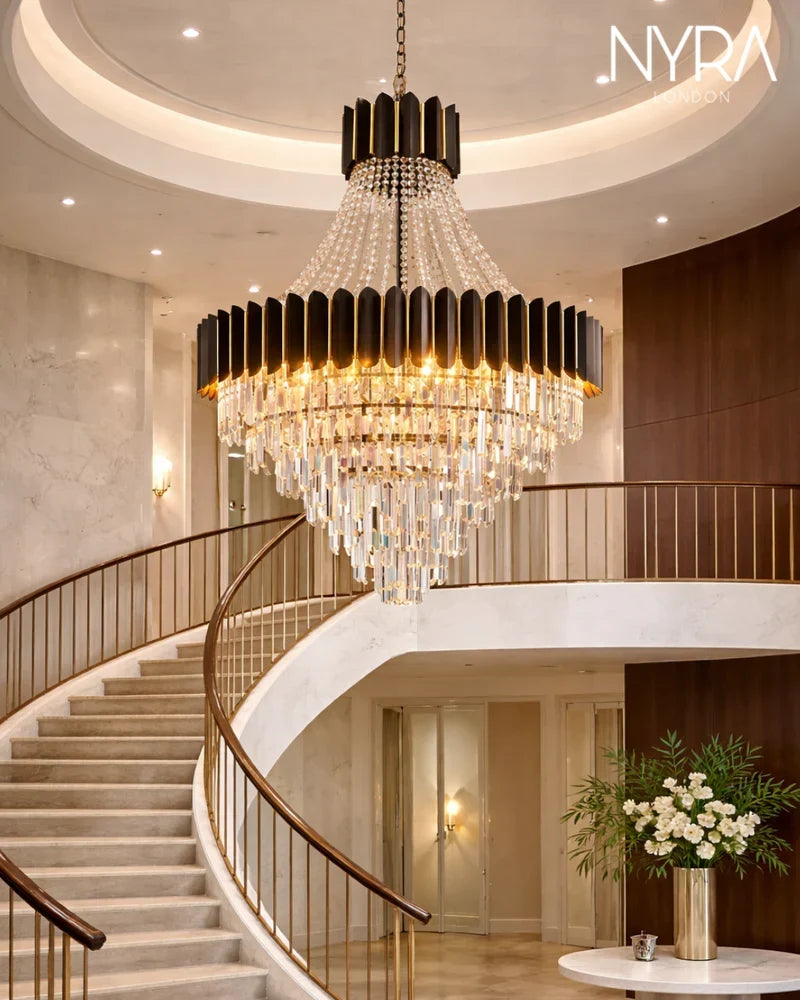
For a stairwell or double height void. Add the stairwell's length and width in feet, use that number in inches as diameter, and set the drop at approximately half to two thirds of total ceiling height. A 6 metre ceiling suggests a 3 to 4 metre drop.
The third question: how high?
Height rules are simple, and they are non negotiable because they are about people's heads.
Over a dining table: hang the fixture 75 to 90cm above the tabletop. High enough that people can see each other across the table, low enough that it defines the table as a place.
In a bedroom: keep the bottom of the fixture at least 2.1m from the floor. If it is centred above the bed, allow 75 to 90cm above mattress height.
Over any walking area: maintain a minimum 2.1m clearance. This one overrides aesthetics entirely. A cascade that looks stunning in a photograph is a hazard if its lowest crystal sits at forehead height above a landing.
General ceiling height: most chandeliers suit ceilings of 2.4m and above. Below that, a hanging fixture will crowd the room, and a flush or semi flush fitting is the better answer.
All NYRA chandeliers and pendants include adjustable cables, rods or chains, so the drop can be tuned on site rather than fixed at the factory. This matters more than people expect, because the right drop is easier to judge in the room than on paper.
Sloped and awkward ceilings
A standard ceiling plate assumes a flat, horizontal ceiling. Hang it on a slope and the fixture hangs at an angle, which looks exactly as wrong as it sounds.
Sloped ceilings need a plate designed for the angle. NYRA ceiling plates can be manufactured to suit sloped or angled ceilings on request, but this has to be specified when you order. It is not something to discover on installation day.
Stairwells are the most common place this comes up, since so many have a raked ceiling on one side.
Wiring, dimming and the thing to decide early
Two questions to settle before installation, because both are painful to retrofit.
Is it dimmable? NYRA fixtures can be made dimmable when paired with a compatible dimmer switch. But a dimmable fixture on a non dimmable circuit does nothing, and a non dimmable LED on a dimmer will flicker, buzz or fail. Decide now, and make sure the switch and the fixture match.
Where are the switches? For stairwells and hallways, two way switching, at the top and bottom, is essential. If you can only switch a stair light from downstairs, someone walks back up in the dark every night. Retrofitting this means chasing walls.
On compatibility: all NYRA fixtures are made to suit the destination country's voltage, wiring and certification requirements, so a fixture arriving in the UK, the US, the Middle East or Australia is built for that supply. Bulbs are included unless otherwise specified. All required mounting hardware is included.
The question nobody asks: how will you clean it
Take this seriously before you buy, not after.
A crystal chandelier 5 metres above a stairwell is unreachable with a stepladder, because you cannot safely stand a ladder on stairs. That fixture will get dusty. Dusty crystal looks worse than no crystal.
Your options are a winch or lowering mechanism specified at installation, which is expensive but the only genuinely convenient answer for a tall void, or scaffold tower access every year or two, which is what most people end up paying for.
The third option is choosing well. Smooth glass and simple geometry hide dust far better than a thousand small crystals. If access is difficult, let that shape the fixture you choose.
What happens on installation day
Unpack and check before the electrician starts. Handcrafted fixtures are shipped with reinforced protective packaging, but transit damage happens. If a component is damaged, NYRA dispatches replacements immediately. Better to find out before the ceiling is open.
Assemble on the ground where possible. Crystal chandeliers often arrive with elements to be attached. Doing that at ground level is safer and faster than doing it up a tower.
Set the drop last. Adjustable suspension exists so you can stand back, look at it in the actual room, and adjust. Do not commit to a length based on a measurement alone.
Two people minimum for anything heavy. This should not need saying, and it does.
A pre order checklist
-
Find the exact weight in the product specifications.
-
Confirm ceiling structure and fixings with an electrician, and fit a brace if needed. Above 10kg, assume reinforcement.
-
Run the sizing formula for your room, table or stairwell.
-
Check the height rules: 75 to 90cm above a table, 2.1m minimum above any walking area.
-
Confirm ceiling height suits a hanging fixture at all. Below 2.4m, consider flush mount.
-
Specify a sloped ceiling plate if your ceiling is raked.
-
Decide on dimming, and match the switch to the fixture.
-
Confirm switch positions, including two way switching for stairs and halls.
-
Work out how you will clean it.
Before you order
The two things worth getting a second opinion on are weight and drop, because both are hard to judge from a photograph and expensive to get wrong.
NYRA offers free one to one video consultations. Send your room dimensions, ceiling height and a photo of the space, and the team will recommend diameter and drop length, and confirm the weight and support you need to brief your electrician with.
Browse chandeliers and staircase chandeliers, or book a free consultation.
FAQ
Can I install a chandelier myself?
Ceiling mounted fixtures should be installed by a qualified electrician. The work involves mains wiring and a heavy object suspended above people. Fixtures over 10kg also need reinforced ceiling support, which is a structural judgement rather than a DIY one.
How much weight can a ceiling hold?
It depends entirely on the structure and the fixing. A standard ceiling rose is designed for a lampshade, not a chandelier. Anything over 10kg needs anchoring into a joist or a brace fitted between joists. Get the exact fixture weight from the specifications and have an electrician confirm before ordering.
How high should a chandelier hang over a dining table?
75 to 90cm above the tabletop. That keeps sightlines clear across the table while defining it as a space.
What size chandelier do I need? For a room, add its length and width in feet and use that number in inches as the diameter. Over a dining table, the fixture should be half to two thirds the table's width, which overrides the room formula.
What is the minimum ceiling height for a chandelier?
Most chandeliers suit ceilings of 2.4m and above, and any fixture must leave 2.1m of clearance above walking areas. Below 2.4m, a flush or semi flush fitting is usually the better choice.
Can a chandelier hang on a sloped ceiling?
Yes, but it needs a ceiling plate manufactured for the angle, otherwise it will hang crooked. This must be specified when ordering, not sorted out on installation day.


Leave a comment
All comments are moderated before being published.
This site is protected by hCaptcha and the hCaptcha Privacy Policy and Terms of Service apply.